Thursday, March 15, 2007

Complexity for Regular Folks, Part 2


Well, i had this post half written, lost my connection to the internet and lost the whole thing. So, this is the second necessarily shorter version... And i am not an expert in any way, so if you have additions or corrections to this, please send 'em along.

Atractors and scalar invariance.

Attractors are the simple rules that determine the direction of a system, its stability, its general trend. There are three groups of attractors: single point, periodic, and strange.

Single point attractors pull the energy of a system to one point or goal. A magnet is one good example of a single point attractor. If you sprinkle iron filings or some pins on a peice of paper and then put a magnet underneath it, the filings and the pins will be drawn towards a single point--the magnet. Another example, from palaeontology (for my kids): Many of us have seen films of palaeontologists working to remove massive chunks of stone--everyone on the dig site is drawn towards the work, lends shoulders and hands to move the boulder. All of their energy is directed towards a single goal--removing the rock. Systems governed by single point attractors tend to produce heroic model management.

Periodic attractors oscillate between two points. We have many experiences of periodic attractors, seasonality in employment, rush hour, and the most common--breathing.
We can cope with and benefit from systems governed by periodic attractors. We can get clarity from goals based on our knowledge of the oscillation. And we can recruit and train heroic model leaders with skills in anticipating and navigating the fluctuations.

Strange attractors were first described in the 1960's by Edward Lorenz (Lorenz attractor and graph) as he puzzled out the mysteries of the weather. While local weather patterns seemed completely unpredictable, when Lorenz modelled more global weather data on a computer, an interesting regularity appeared. The equations consistenty produced graphs in the shape of butterfly wings. At a larger scale, there were obviously rules at play that produced a predictable pattern. What those rules were, however, was difficult to tell, hence the name strange.

Complex systems are shaped by strange attractors that can be governed by a few simple rules. For example the movement of flocking birds is governed by three simple rules: stay equidistant from your neighbour and other objects, maintain the same speed as your neighbour, head toward the centre of the group. These simple rules allow a flock of birds (or fish or bees) to be 50 times more sensitive to changes in their environment than any one individual. (So complex systems are not well suited to the heroic leadership model. They are governed by interdependence, and so need a more interdependent style of leadership.)

So, to recap, strange attractors affect the flow of energy in complex systems. Strange attractors are comprised of a number of simple rules that interact with one another to produce the visible results we can observe. Discerning what these rules are is supported by certain attitudes and behaviours that Westley et al delineate--and that i will chat about in another post (hopefully also drawing some links to Spiral Dynamics).

So what is scalar invariance? Scalar means scale, or size. Invariance means not variable, unchanging. So put together, scalar invariance means that complex systems tend to act the same whether you are looking at only a few individuals (the micro level) or a mass (the macro level). You can extrapolate the simple rules governing the attractors of large systems by looking at the parts of those systems. In very simple terms, you can see the whole in the parts. As Blake would say, "the world in a grain of sand."

Both of these characteristics of complex systems are important to those wanting to effect social change. Identifying the strange attractors, and then looking under the surface to find the rules governing the attractors will have more leverage than attacking the surface characteristics. And scalar invariance means that local knowledge and expertise can effect change with global impact. And that small-scale efforts and experiments

Which leads us to one last concept from chaos science: complex systems are highly dependent on initial conditions. I am linking this to concepts from Aikido. In Aikido we have a very simple math. All systems have an energy of 10. If someone is attacking you with a force of 7, you only need to respond with a force of 3 to complete the system. In dealing with complex systems, the attractors hold a lot of the energy of the system, so a small input of energy at the right place and time can have significant results on the outcome.

There is good news here for those of us looking for ways to influence change. No guarantees, but lots of possibilities.

There is a lovely little animated game using attractors that you can play over at thecleverest.
Strange Attractor equations and graphs.
Formal definition of attractor.
Interesting discussion with illustrations of the four attractors of chaos science with speculative parallels to consciousness.
Some very cool 3-D images of attractors and other fractals.
Good next step for those wanting more information on attractors and complexity theory: Attractors Everywhere.

Next: a few more additions to our growing list of skills and attitudes for thriving in complexity.

Wednesday, March 14, 2007

On hosting meaningful conversations

I am busy preparing a training manual on public speaking and public conversations for non-profit staff and volunteers. So, i have been musing a bit this morning on why i love facilitation when it is about hosting meaningful conversations.

What arose for me today was depth. I love asking the questions and holding the space for the questions that lead to depth. That let us get beyond the surface to the complexity that always is present. And i love it when that complexity gets unpacked, unfolded out in all its brilliance and unknowability. I love it when we get to a level of complexity where we must act out of the essence of who we are and not merely from what we know.

Friday, March 02, 2007

Complexity Theory for regular folks- pt 1

The subtitle for this post should probably be: And why should i care anyway??

Authors Brenda Zimmerman, Frances Westley and Michael Quinn Patton give a compelling and highly readable answer in their new book, "Getting to Maybe" (Random House Canada, 2006). The other really cool thing about this book is that two of its authors are Canadian. Woohoo!

The short answer to why care about complexity: because it's how the world works and perhaps more importantly to many of us--it's how little old us can change the world--from where we are--NOW.

I have been working away in my brain on a blog post about working on the edge. And the edge i have been working on is all about complexity. It is the rub i find everyday in my conversations with leaders of organizations, with other consultants and with my friends and neighbours. Most of us have been taught skills and conditioning to help us thrive in a complicated world. Those skills are all about organizing, managing, and controlling. We are increasingly frustrated when these skills don't produce the results we are looking for.

In my work and in my life i am constantly communicating that the world has changed. We now live in the midst of complexity. And that calls for a very different skill set. A skill set that is often at odds with the way we have worked and lived in the past.

Over the next little while i want to share with you some of the skills, competencies, and mindsets (and reactions to them) that i am seeing emerge. I will also share the insights i am gathering from reading , "Getting to Maybe". And i will try to make the science behind complexity theory accessible to those of you for whom the words strange attractor, iteration, fractal, and scalar are seldom found in your recreational reading.

To begin, the number one reaction i see when folks start to explore working in ways that meet the demands of complexity is fear. This fear can manifest as resistance, hostility, anger, disbelief, mistrust. I believe that the fear has two main sources: certainty and grief.

What do I mean by certainty? When we make decisions, we like to feel that we have based them on an adequate amount of data that we can trust. When working with complexity, we often have to make decisions before we have that perfect data--in order to benefit from emerging trends and patterns. This can feel very uncomfortable--like leaping from a ledge without knowing what is below you. Even if the jump is a relatively short one, we all want to know that we are going to be okay--and that is something we can't know until we've landed. Some skills to cultivate: comfort with risk, ability to function with paradox, flow, letting go, intuition, pattern seeking, trust.

What do i mean by grief? In the past few months i have had the chance to learn a lot about grief--especially about grief as it is experienced by children. And of course, we are all children. What i have learned is that change, ALL and ANY change evokes the grief response. Think about that. In all change there is a loss--even if there is also a gain. Now consider the pace of change in the past 30 years. Birgitt Williams says, "there is always grief in the room". What does grief look like? Resistance, denial, anger, depression. When folks begin to understand that clarity is no longer possible (replaced by more relative qualities like discernment) and that paradox, risk, and flow are the new names of the game-most of us are looking at a truckload of loss. Some skills to cultivate: compassion, openness, letting go, resting down, faith in others and self.

So what are the new skills, attitudes and competencies for living in a complex world? For starters, as Westley et al state, "Getting to maybe has almost nothing to do with certainty and everything to do with serendipity, conviction, risk taking, and faith." Not very popular words in the offices of the world.

I hope together we can explore more of these new ways of thinking, living, working--being--over the coming weeks and perhaps generate a great resource for us all.

In the next post i will take a look at some of the jargon of complexity. Strange attractors, and scalar invariance. And why would you care? Because attractors are the tipping points of the system and scalar invariance helps you spot patterns at the micro level that can promote change at the macro level. Can't wait, can you ;)

Wednesday, November 29, 2006

Open Space memorial


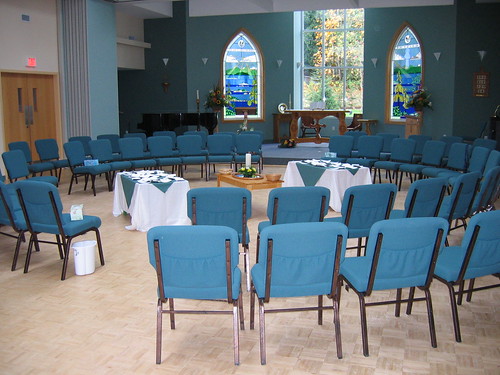
20061111_Funeral Flowers_9_7, originally uploaded by the view from in here.

While it feels strange to discuss my grandfather's Life Celebration in terms of facilitation practice, i want to capture and share the learning. I feel grateful to the minister of the Anglican Church where the celebration was held as he was knowledgeable about and supportive of Open Space. I am humbled by my grandmother's trust in me. She really has no idea what i do, and no understanding of what OS is, but still she was open to letting me share what i had to give. And for that i will be forever grateful.

I did not use pure OS--as you might imagine. My intention was to both honour my grandfather's life and to provide a meaningful ceremony for all present. In the end, i used a confluence of OS, circle, and Whole Person Process.

We set up in the afternoon, two days before. We were expecting about 60 people, so we set up in concentric circles of about 30 chairs each, with four aisles aligned to the altar and the main entry door of the church sanctuary. We placed three small coffee tables (okay one coffe table and two wonderfully colourful tables from the Sunday School) in the centre of the circle. It took a while to get them positioned properly, but in the end, they supported the energy flow by inviting people into the circle and creating a clockwise flow. We covered the tables with white and green church linen. On the central table, we placed an oval mirror and on this a floral centre piece with a candle. The inspiration for this was from circle practice where the fire in the centre draws people back to spirit when the conversation gets difficult. On the other two tables we placed photos of my grandfather from different times in his life; they were placed upside down. The photos were to be used for the transfer-in process from WPPF.

On the day of the ceremony, people gathered and i rang the bells to begin. I introduced myself and then introduced the minister who led everyone in prayer. Then it was time to open the space. I walked the circle
and invited everyone to look around and see who was here with us...to greet each other with their eyes. The principles were implicit rather than explicit--this was not the time for formality or rigidity--everything needed to be deeply personal.

Whoever comes became: We are all family, all friends. There are no strangers here.
Then i said, "We are all here to celebrate Len's life--to honour the life that he led and the legacy he has left. We are here to share a few of the moments where his life touched ours. To share what he meant to us--as best we can at this time. Please know that your tears are a blessing to that legacy and so is your laughter. His life was a special gift to each of us--and for a few minutes today, we can share that with each other."

Then it was time for the transfer in. I said that we had a gift for each of them and they were invited to come up and choose a picture from the tables. I invited everyone to believe that whatever picture they chose was the one they were meant to have. We took a minute of silence to reflect on the picture, on what it told us about Len. Then i invited everyone to find a partner or two and spend ten or fifteen minutes sharing whatever they wanted to. This is from WPPF and allows everyone to warm up their voices (it's tough to stand up and speak at these things--and my grandmother was scared that no one would). It also gives those who just couldn't possibly get up to speak a chance to share what they needed to share with someone else.

I rang the bells again after about 12 minutes and we all took our seats again. I invited each person who felt like it (and nobody had to) to come and take the microphone and share a memory of Len or what he had meant to them. I added that: "There may be silences and that is fine. We are all here to share what we can and sometimes silence is what we need to share."

People got up and shared stories, some read what they had brought to share, email messages were shared out and read into our circle. At one point my mother suggested that i offer to take the microphone to anyone who felt they couldn't get up. I honoured her request and was glad i had. It's not what i would usually do, but grief needs accommodation. There were several people who wanted to share, but just couldn't bear the idea of meeting anyone's eyes. They were so glad to be able to contribute by having the mike passed to them.

In about 50 minutes it felt like we were done. I said, "We may be finished, we may not be." i gave us all a minute in case someone was still gathering their thoughts. Then finished up with, "Our formal time for sharing is ending." I invited the minister back into the circle for a final blessing. When he finished i thanked everyone for what they had shared and for their presence and support. I invited those who wanted to do so to light a candle in Len's memory from the one on the central table. And we adjourned for refreshments and more sharing. The circle was open. The whole ceremony took about one hour and fifteen minutes.

Open Space invited the presence of Spirit and let us all feel each other's presence. It allowed for each of us to contribute as we felt able. It honoured the grief present and gave us all a brief glimpse of what lay beyond it. Circle supported us with fire in the centre, the heart of family and community. WPPF supported us in bringing our whole self present. It supported healing by integrating both sides of the brain, by inviting our voices, and by helping us to hear each other with open hearts. It provided a liberating structure to what might otherwise have felt overwhelming.

The feedback has been very positive. Many people have remarked on how fulfilling it was--on how it was just what they needed. That was what i had hoped for: to provide an honouring space and time that would be meaningful and healing for those who came.

I did not have long to prepare for this, as you might imagine, so it just flowed from my heart and what felt right and possible in the moment for all of us closest to it.

Monday, November 06, 2006

In Memoriam Len Turner 1913-2006


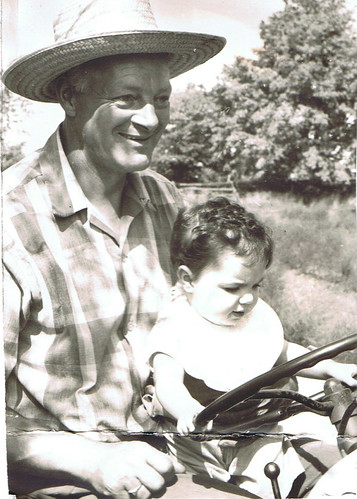
gramps and me, originally uploaded by the view from in here.


My Grandfather, Len Turner, died just after 11:00 on Saturday night. It has been a long 14 months and it was a longer 4 days for those of us who sat by his bedside as he struggled for each breath. His final moments were peaceful and we all feel a huge sense of relief that he has finally found freedom after being a prisoner in a body that no longer served his will.

He loved life so much. He loved this beautiful earth and didn't want to miss a minute of what might happen next. His love for his family, for my grandmother, for my mother, for me and my brother was a blessing and privilege to witness and receive.

His stories, his humour, his smiles, his ingenuity, and his gentle strength have been a daily part of my life for 40 years. He was a blacksmith's apprentice, a welder, a builder of planes, a fireman, a maker of jewelery, an artisan, a handyman, a gardener, a trickser, a farmer, a fisherman, a naturalist, a husband, a father, a grandfather, a great-grandfather.

I have been thinking a lot over the past few days about all of the things that i learned from him. He taught me to fish. He tried to teach me to fight (but i was a hopeless non-violence practitioner, even at ten.) He taught me how to light a campfire--my status as a fire goddess is largely due to his example. But of all the lessons that i learned from him, two stand out as most important.

I learned from him the belief that what you can imagine you can create. He could coax beauty and usefulness from anything--bits of wood and string, scraps of metal, discarded perspex-- with a bit of glue and paint, or some whittling, under his hands they became a mobile of airy delight, an eternal rose, an exotic parrot. Thanks to him i can see beauty and possibility everywhere.

He also gave me the gift of companionable silence. You can't fish and chatter. You can't see a deer or a purple finch or a drowsy snake if you're always filling the silent spaces. Those daily adventures in the woods, and wandering along streams and beaches--quiet. Listening together for the mystery in the spaces of life.

I love you Gramps. And i can't quite yet absorb that you're gone.

Monday, October 09, 2006

horror--and its remedy?

Today a colleague sent me images by email of an 8-year-old boy having his arm crushed by the wheel of a car for stealing bread in a market. Last week, as i sat in my car in the ferry line with my children waiting to take them to school we listened to news of a mother who had murdered her children. The day before, we heard news of ten girls bound and shot in an Amish school. Every day they die of hunger. Every day they die of AIDS. Every day they are shot by militias because they got in the way, or they were homeless. Every day they are neglected in orphanges. Every day they suffer in the bondage of slavery. Every day they watch their mothers beaten and murdered. Every day they are beaten and murdered.

I sit here almost incapacitated by horror. There are images and sounds and stories of torture and murder burned in my memory from the past fifteen years of work. I know i am tired. I know i don't usually consume ANY media for good reason. I know I will wake up in the morning, having managed to fall asleep somehow, and get on with my day, my work, loving my children, my family, my friends. I know that somehow, beyond this moment, i will find again the hope and determination to imagine a future for my species that is free from hatred, fear, and cruelty. A future where each child can grow up unharmed. I will somehow, once again manage to choose compassion over despair. But right now all i can do is shake and cry with the horror of what we can do to each other.

This news that bathes and barrages us with the basest of who we are, depletes us and alters us in dangerous ways. We can lose hope; we can lose faith in ourselves and our species. We can slide from horror to numbness to incapacity. It fuels our flight from reality into endless entertainment. It fuels hatred and suspicion. And most of all it fuels fear--the kind of fear that can be used to manipulate, to silence, to subvert, to oppress.

I don't know if those photos were real. They looked real. They could have been faked. They could have been from a movie. They could have been staged by the CIA or any number of other special interest groups dedicated to promoting hatred between people to further some project or other through a disinformation campaign. I'll never know the truth. Neither will you. What i do know is real is the trauma in my body. The disruption at a cellular level of my self and my energy. My heart contracts in self-protection. Can you feel it too?

It hurts--and it's hard work!--to open and soften that heart again. I am working at it as it type this because i choose to believe that compassion is the only response that will change us--that has any chance of success. And so i breathe in the suffering and terror of the child and breathe out compassion--because it's all i can give him--because i choose to believe that at some level it matters. And then it gets harder--i extend compassion to the man who is holding him down (it could be his father) because i choose to believe that only someone who is experiencing tremendous suffering could harm a child that way. So i breathe in that suffering and breathe out compassion--because i choose to believe that it matters. And i choose to break the cycle. I will not perpetuate the energy of hate and fear.

I don't believe it's about right and wrong anymore. I choose to believe it's about the energy of love and compassion versus the energy of fear. And i choose to believe that it matters at the level of energy--regardless of distance or time.

And i say choose to believe, because i have learned that faith is not a rock that we stand on, but is an activity we engage in moment by moment as life presents us with each new opportunity to be present in a different way.

So the horror and despair are receding--replaced by the ache of a soft and open heart.


-----author's aside to self:
A wondering to capture for further reflection: Things seem to be moving beyond questions--or at least verbalized questions--and into a realm of being or flow. There seems to be no question relevant other than to perhaps be a question. Or be a response. Perhaps we can find repose in our response-ability?

Thursday, September 21, 2006

balance

So much one could say about this...but sometimes pictures are worth more. And when it's pushing one A.M. and one's children are heading off to their first day of school in the morning, and one is still jet-lagged and totally bagged...a picture it will have to be.

If you haven't seen the incredible West German short film BALANCE, then do. It's seven minutes you won't regret. This is a pretty decent version up on youtube.

Tuesday, September 12, 2006

questions on human competencies and complexity

In our workshop today there were some really interesting discussions and questions raised. Marquis Bureau suggested that perhaps we should look at nomadic people for the skills and competencies that would help us to function and thrive in more fluid and changing organizations. That led me to think of the Lakota people who offer that their particular genius is in human relationships (Dr. Martin Brokenleg). And we certainly could use improved competencies in that area. Birgitt Williams pointed out that many nomadic people still had a cycle of regular places that they stayed. This leads to a couple of questions...what other competencies do nomadic people demonstrate that might be helpful for us to learn from? Are there any truly nomadic people--those who have no regular round of locations?

Another question that arose as we pondered where untapped treasure troves of human understanding might lie, was: When was the last time (if any) the human species (or its predecessor) has been faced with this degree of complexity and change? I posited the Ice Age. It would be really interesting to take a look at this and see not only if there are times that compare well, but what arose out of those times. Memes for example; that we may still be carrying today.

Well, as you might expect after a long day of stiff brain work, i'm toasted. So i leave you to ponder along with me. Looking forward to your thoughts.

(Sorry for the lack of pics. I forgot to bring along the camera cable.)

Monday, September 11, 2006

argghhh. social engineering meets the web?!?

This is one of the horrors i imagined happening when i fully grokked what Stephen Downes was talking about during Northern Voice 2005. When he was trying to disenchant us all about the big spike-long tail thing and started getting into how power, control, heirarchy, etc is built right into the coding that makes our beloved web work.

The last thing we all need is software that engineers social interaction--facilitates fine, engineers....eeek!!!

Sunday, September 10, 2006

community and leadership

Great post from Gardner Campbell over at Gardner Writes on leadership and growing community:
On the topic of leadership, this quotation also seems striking to me.

He who loves community, destroys community. He who loves the brethren, builds community. Dietrich Bonhoeffer

With allowances for the androcentric language, which I’m confident Bonhoeffer meant inclusively, the observation is keen and apt. The idea as I understand it is that communities are built out of persons, not out of ideologies, and that one of the most insidious traps a leader can fall into is that of advocating community while evading engagement with persons in all their alterity, all their knotty complexities.

There's more good stuff to read here about personal integrity and learning communities.

There's a real link here to what we are practicing with Community Weaving. Weaving a social safety net and creating a village effect by connecting with one person at a time, meeting them where they are, however they are, and inviting them to ask for what they need and offer what they can--believing that the resources required to resolve local problems reside in the hands and hearts of local people. As each person responds to an invitation to step forward and take responsibility for what they care about, they become a vital and creative organ in a self-organizing body of increasing civic health and wellbeing.

I am working with People for a Healthy Community on Gabriola to pioneer this approach in Canada. I also presented on this approach when i was in Moscow and there are now several initiatives begun there as a result.

Well, i am in North Carolina with Birgitt and Ward Williams and a group of wonderful folk from around the world. We are all learning together and sharing our experiences of helping organizations integrate Open Space principles into their daily way of working.

The conversations are deep and there is much to ponder and much fodder for future bloggin'!

Saturday, September 09, 2006

Starfish tracks


Starfish tracks, originally uploaded by the view from in here.

On our jaunt to Sandwell Park a couple of days ago...we saw this beautiful rarity of nature: a starfish making tracks. It was about 30 cm across and moved about 60 cm every five minutes or so--a real racer!

The beauty of the tracks just stopped me.

Friday, September 08, 2006

fishing for words?

you have to be still
for the words to come
like minnows under
cedar roots
even a shadow of movement
and they flit back
into darkness

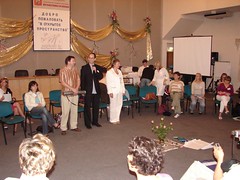
Moscow OSonOS photos up on flickr


DSC07303
Originally uploaded by the view from in here.


Hi everyone,

Finally! I have uploaded the official picture set from the OSonOS proceedings in Moscow. You can view them here.
Descriptions will have to wait until later.

The photos of my trip, with basic descriptions are here. Some of the photos still need work, but at least they are all up.

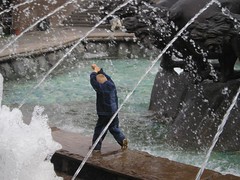
And kids are kids everywhere. Child playing in a fountain near Red Square.


P8110406
Originally uploaded by the view from in here.

Thursday, September 07, 2006

another reason for more open space in schools

Stephen Downes posts this excerpt and comments on Kindergarten Gulag:
The headline says it all, doesn't it? "Instead of story time, finger painting, tracing letters and snack, first graders are spending hours doing math work sheets and sounding out words in reading groups. In some places, recess, music, art and even social studies are being replaced by writing exercises and spelling quizzes."

I would add as well that a fundamental purpose of recess, arts and social studies is to promote freedom by enabling it - and so I wonder about this unfree generation of children now being raised. Remember, how we used to hear, that freedom and democracy may have flaws, but they are much better than any other form of government? I wonder when people stopped believing this, and how it is that they feel that a command economy is somehow better. Remember - the lessons we teach our children are based, not on the content we teach, but on how we act, how we behave. Authoritarian teachers raise dictators, even if they teach Rousseau.

"To promote freedom by enabling it" isn't that what Open Space is all about? I appreciate all the work done by open space colleagues to introduce OS into schools at any level. There is a collection of stories about this here.

And this is why i can't send my children to public school. But i still feel a deep unease and concern about the reasons underlying the way the school system has changed (and not changed) in the past 35 years. Out of seven of my children's friends who are starting school this year, only one is attending the mainstream public school here on Gabriola. With the funding structure of the public system, what does this mean to the future of public education? And i believe that future does matter--just ask someone from a country that has no public education system.

Some of the things i wonder about: Is the system being purposefully starved and left to rot in a backwater of unproven and inappropriate methodology? Is it hopelessly out of step with the needs and desires of modern parents for a reason--or is it just an accident of complexity? Is it worth saving? Is it possible to save? Is this the beginning of a two-tier system or even the leading edge of the demise of the right to public education, or the unfettered privatization of that system?

A real catch-22 for parents who care--not just about their own children's education, but all children's access to education (as my friend Keira has so passionately described to me--i know, you will blog oneday, in your best time).

So, while i reluctantly entrust my children to a semi-private learning environment, i ponder about a new publicly supported system of distributed learning networks--locally driven, globally linked. And a new social culture where parents and community are able to create the learning space our children are asking for. Any thoughts?

Just read my blogroll and there is more on the Great Canadian Homework Ban and links to some great resources at parkinglot.

Sunday, September 03, 2006

Design in translation

Perhaps not the deepest, or most enthralling learning from Moscow OSonOS, but a useful one to capture is about designing an event where there will be a lot of translation happening.

A few things i learned:
  1. Do not attempt to cut short the time for the sessions. Alot at least the 1.5 hours recommended and perhaps even extend that by 15 minutes or so. I have noticed the dampening effect of shorter time slots before, but it was more pronounced here where conversations were all translated and so the effective conversational time was often halved. (But we got better at getting more concise as the days progressed.)
  2. Allow a bit more time for the opening and closing segments. Again, with translation, we ran into trouble staying on schedule for the first session each day (there were some other reasons for that, too...) and inviting a focus to the closing comments and reminding folks to please keep things brief at the end of the day is a necessity.
  3. Using translators that have a grasp of the subject matter is a huge benefit. For those of us who have no experience with translating into other languages, it is easy to forget that a lot of words and concepts do not have direct translations and that subtle shades of meaning can be very tricky to convey. Translators who have some exposure already to the field of conversation can really enrich the experience for everyone.
  4. Inviting volunteer translators from within the participants can really boost your translating power.
  5. Translation support in the newsroom and extra hands on deck to help get all the reports in order would be handy (especially when the character set is different--very tricky to match up reports with their translations if you not only don't speak the language, but also can't decipher it either...).
Well, those are the main points i noticed. Did you notice anything else Raffi?

I want to commend the organizing team of OSonOS in Moscow for creating an incredibly flexible and rich translation environment. It was a wonderful experience.

Спасйбо!

Saturday, September 02, 2006

a few thoughts as an update

Still returning to the world. A world that is in more flux and flow than usual--and that's saying something. It took me about five days to recover from my trip to Moscow. I slept a lot of that.

I have so much to report about that trip that i can only hope to capture it all before it slips away. i have some thoughts recorded and ready to jumpstart me and i wanted to just check in quickly with you all--to let you know it was an incredible experience and that i returned home safe and sound.

OSonOS. Three days out of time and place. i am still left in awe and wonder at how deeply we can know each other in so short a time. Friends, and more than friends-- a family of the heart and soul--discovered there. Dear ones who will dwell now always and everpresent in my heart--Mussarrat, Raffi, Birgitt, Carol, Netra, Funda, Lada, Marina, Alex, Vera. And those who i carried with me in heart and Spirit--so that their essence and contributions could also bless that gathering--Lisa, Chris, Michael, Tree, Peggy. You are a beautiful host to hold in one's heart.

And after the event, Raffi supported me in hosting a Community Weaving workshop in Moscow. I was humbled again by how powerful people find this approach and how quickly they are willing to grasp it and run with it. Community Weaving is now taking root in organisations in Moscow, Ukraine, Chechnya, the Altai region, and the Baikal region. Those attending plan to use it to support their work in restorative justice, juvenile justice, homeless women and children, preservation of the environment, and indigenous rights.

Much has happened since my return...the first family camping trip (with both dogs!!) to Newcastle Island; a surprise visit this week from my brother and his family; getting back to work--or trying to; preparing to go off to North Carolina week after next; and then the start of school for the boys.

Yes, school...many of you know how hard we have struggled with this decision. And in the end we have opted to go with Montessori. I am still torn--i would love to be able to keep them home--but without unreasonable sacrifice and constant chaos, neither of us can find a way at this time to make it work. So far, we like what we are hearing--own pace, child centred, co-learning atmosphere, follow their passions. We will see how it goes. At least i don't have an anxiety attack when i walk into the place. For those who are also struggling with this decision, Chris has some cogent and heartfelt thoughts on the subjects of homework and unschooling.

Will be slowly returning to this space with stories and PHOTOS!!! from the trip as my time and energy allow over the next month.

Blessings to you all and thank you for your patience over this last extended dry patch.

Tuesday, August 01, 2006

Road to Moscow part 1

So here I am, sitting in the cafeteria of the Queen of Oak Bay on my way to Vancouver. I left home in a cab this morning, the car having lost a brake cylinder yesterday—Oh Murphy loves me yes he does! So the journey began at 9:30 am PST. I took the 10:05 am ferry (Quinsam). This is the 12:50 ferry to Horseshoe Bay. I’m off to get my bus ticket in a few minutes that should take me all the way to the Airport (YVR)

Leaving was difficult. The boys were all sad that I was going and I felt badly about having to leave in the taxi and not be able to set our own time and pace. It has been a difficult decision to go to Moscow and I still feel somewhat conflicted about it. I’m not sure if either the boys or I am ready to be away from each other for this long. I’m sure the exhaustion of the last week isn’t helping me cope as well as I might either. The trip is truly under way. And I know that the anxiousness I feel now will slowly ebb into a growing excitement.

I am practicing my Cyrillic in an effort to be able to make sense of signs and such. I’ll catch up on some sleep on the bus. I may try and make a podcast of the journey. Either way, see you later.

Monday, July 24, 2006

Alien Abduction--No Really

Okay, i was going to claim to have been abducted by aliens, but it was really just way too much work and needing to spend more time with my children. I cut my childcare days down because we were seeing symptoms of real stress in the kids and so, with more mommy time, something had to give and unfortunately it seems to have been this space.

I have missed you all, and hope to be able to come back with shorter posts once or twice a week. We'll see. I can but try.

Next up...countdown to Moscow....Day 8

Thursday, March 23, 2006

An Appreciative Approach to Community

Well, you all know how i (and many of you) dream about intentional community. Well, i've been having these amazing conversations lately that have spawned some questions around a different approach.

Talking with seasoned vets of communes and other intentional communities has highlighted just how difficult it is to artificially construct a viable community. How leadership is usually a thorny issue--a bit of a catch-22 really--you need a strong and visionary leader to actually make one of these things happen, and then after a few years, everybody is sick of the "controlling, overbearing, sob"... And then there's money...some have it, some don't; some earn it, some don't. How do you make it all equitable and what kind of internal economy will help the community flourish? And what about the interface with the external economy? Then there's the question of numbers--how many folks do you need to make a vibrant and viable community? And what about the mix of skills and professions (to say nothing of personalities or ages)? And this is just scratching the surface.

So, i have started wondering, what might emerge if i began to apply an appreciative approach to the issue of intentional community? What if i looked at the community i already live in as one which is largely functional, viable, and sustainable? What would change if i tried believing that the distance between what we have and what we need to create is very small? What would be different if i began to ask, "What is working well here and how can we grow more of it?" instead of, "What is wrong here and how can we escape it?" I am really interested to see what small steps and actions suggest themselves to me as i sit with this new set of wonderings.
It is absolutely entrancing to my writer's mind to look at my community through this new lens. What if i imagine that my community is an intentional community that has been thriving for 100 years? How would i approach my neighbours differently? What would i think was possible? How would my assumptions about how change happens be different? What if i began acting as if Gabriola is an intentional community of 5,000 souls that is threatened by external and internal changes and pressures? What invitations could i issue from this new perspective?

It is just flipping the paradigm around. I would be bringing intention to my community rather than attempting to attract a community to my intention.

PS: Further to my post of March 02, here is a link to a letter from Starhawk reflecting on her work of the past three years and in remembrance of Rachel Corrie, the peace activist who was crushed to death by a bulldozer in Gaza. You can access her other writings about her work in New Orleans and at the G8 summit via this site also.

Wednesday, March 22, 2006

For your listening pleasure

I have been wanting to post about the wonderful music coming out of CHLY Community Radio for a while now (available on the web). One of my favourite shows, Third Stone from the Sun (Wednesdays from 3:00 pm to 6:00pm) is hosted by friend and fellow Gabriolan Fergus Foley. George and I saw Fergus tonight on our way to and from Nanaimo and he very kindly sent a set out to us. Thanks, Fergus!

DSCN2379

This is a pic of Fergus relaxing at his Gabriola digs. Several people are encouraging Fergus to start a wee blog, so perhaps we will be hearing more from him in the future. At the moment, you can find his top 10 list from 2005 here.

Some of the other shows i have been checking out...Eclectic Celtic--just what it sounds like and American Crossroads--live bluegrass--oh yes, and Indiecontextual--it's an absolute hoot if you are, were, or love a GRRL and serious RnR. You can check out the whole line up here.